Short answer: There is no single best Digital Product Passport (DPP) software for every small fashion brand. The right tool depends on where your product data lives. Brands without a PLM usually do best with a tool that builds passports from product development data. Brands with deep supplier programmes need a traceability-led tool. Brands that need LCA need an LCA-led tool or partner.
Last verified: 26 October 2026. Written by Klas Kristiansson, co-founder of Portia and Managing Director of the Stockholm design and apparel agency Desinder.
We make Portia, so read this as a comparison written by a vendor. To keep it fair, every tool is scored on the same seven criteria, using only what each company publishes on its own website. Where a company does not say something publicly, we write “not stated publicly” rather than guess. Tools are listed alphabetically. This is not a ranking.
How we compared the tools
On 26 October 2026 we read each vendor’s own website: homepage, Digital Product Passport pages, integration pages, pricing pages and FAQs. We did not test any product hands-on, including the paid tiers of other vendors. Every tool was scored on the same seven criteria:
- Type: which of the five types of DPP software the tool was originally built as: marketing-led, traceability-led, LCA-led, layered (infrastructure) or PLM-native.
- Supplier data: how supplier information gets into the passport, and how many tiers deep.
- LCA: whether the tool calculates life cycle assessments itself, or imports impact data.
- Shopify: whether a Shopify integration is described publicly.
- Granularity: whether passports can be created per model, per batch or per individual item.
- GS1: whether GS1 Digital Link identifiers are described publicly.
- Pricing model: how the vendor sells, such as published plans or a quote. We list the model only, not prices, because prices change often and depend on volume.
A “not stated publicly” cell does not mean the tool cannot do it. It means we could not confirm it from the vendor’s public pages on the date above. Vendors can ask us to correct anything that is out of date.
The comparison at a glance
| Tool | Type | Supplier data | LCA | Shopify | Granularity | GS1 Digital Link | Pricing model |
|---|---|---|---|---|---|---|---|
| Arianee | Layered (open DPP infrastructure) | Not the focus; data is imported | Not stated publicly | Shopify plugin announced | Scoped per project | Yes | Project quote |
| EON | Layered (product identity) | Connects supplier and traceability data from other systems | Not stated publicly | Not stated publicly | Product, batch or serialised item | Yes, plus EPCIS 2.0 | Sales-led, not published |
| Fairly Made | LCA-led and traceability-led | Tier 1 to raw material, with an in-house analyst team | Yes, built in | Not stated publicly; API to PLM and ERP | Per product reference | Not stated publicly | Named plans, quote |
| PicoNext | Marketing-led | Not stated publicly | No; footprint sections in templates | Yes, Shopify app | Item and batch level on some plans | Not stated publicly | Plan tiers by number of passports |
| Portia | PLM-native | Tier-1 supplier logins | No; impact data imported | Yes, one-way push of passport data | Model, batch or item | No (QR codes) | On request (demo) |
| Renoon | Layered, with advisory and managed services | Supply chain traceability module | Can structure and calculate product-level impact data | Yes, ready integration | Model, batch or item | Not stated publicly | Quote |
| Retraced | Traceability-led | Multi-tier mapping, AI document checks | Not stated publicly | App not currently listed on the Shopify App Store | SKU and EPC identifiers | EPC identifiers mentioned | Demo, quote |
| Tappr | Marketing-led, with supplier tracing | Trace module, tier 1 to tier 4 by invitation link | Not stated publicly | Yes | Item (SGTIN) or batch (LGTIN) | Yes, by default | Published plans; extras quoted |
| TrusTrace | Traceability-led (enterprise) | Multi-tier, primary data from suppliers | PEF calculation, in platform or via a partner | Not stated publicly; open API | Item level, per size and colour | Follows GS1 Digital Link | Quote |
Sources: each vendor’s own website, read on 26 October 2026. Full list at the end of the article.
Best for: one line per tool
- Arianee: brands that want open DPP infrastructure across several product categories, with GS1 Digital Link identifiers and a direct route to the EU DPP registry.
- EON: brands that want one persistent product identity behind passports, resale, repair and authentication, connected across many existing systems.
- Fairly Made: brands selling in France that need LCA, the French environmental cost score and AGEC data, with supplier tracing done by an analyst team.
- PicoNext: Shopify stores that want consumer-facing passport content generated quickly from existing product listings.
- Portia: small and medium fashion brands without a PLM, or with one they want to replace, that want product development and passports built from the same data.
- Renoon: brands that want advisory and managed services alongside the platform, and a team that runs the setup work for them.
- Retraced: brands whose main job is supplier onboarding, document checks and supplier lifecycle management, with the passport as one output.
- Tappr: brands that want GS1 Digital Link QR codes, published plans and post-purchase add-ons such as registration, resale and warranty.
- TrusTrace: larger fashion and footwear brands running multi-tier traceability and environmental footprint programmes.
The tools in more detail
Arianee
Arianee describes itself as open Digital Product Passport infrastructure for ESPR, the Battery Pass and WEEE, from the factory to end of life. Its site highlights GS1 Digital Link identifiers and pushing passports to the EU DPP registry, and it covers batteries, appliances, watches and fashion. Its FAQ says cost depends on product volumes, identifier granularity, available data, integrations and services, so you prepare a catalogue sample and get a project estimate. A Shopify plugin is announced in its developer changelog. Checked 26 October 2026.
EON
EON has built product identity infrastructure since 2017 and says it works with more than 50 companies on DPP programmes. It is a technology partner in CIRPASS-2, the EU-funded DPP pilot. Its DPP page describes persistent digital IDs for products, batches, serialised items and materials. It supports GS1 Digital Link and EPCIS 2.0, and QR, NFC, RFID and woven label carriers. It also covers resale, repair and authentication. Pricing is not published. Checked 26 October 2026.
Fairly Made
Fairly Made is a French traceability and environmental impact platform for fashion, textile and leather, founded in 2018. Its analyst team traces products from tier 1 to raw materials through a supplier interface. It runs LCAs based on ADEME’s Base Empreinte and offers an ecodesign module. Passports reach customers through QR codes, URLs and widgets. Its plans (Impact Starter, Full Suite and CSR Ultimate) are priced on scope and the number of product references, through a quote. It connects to PLM and ERP through an API. Checked 26 October 2026.
PicoNext
PicoNext is a DPP platform built around a DPP Planner with templates and a generative AI assistant that summarises product data into passports. Its pricing page lists Essentials, Pro and Enterprise plans by number of passports, with item- and batch-level support and API access on higher plans. Prices are not shown on the plan table. A Shopify app creates passports from Shopify product data. Checked 26 October 2026.
Portia
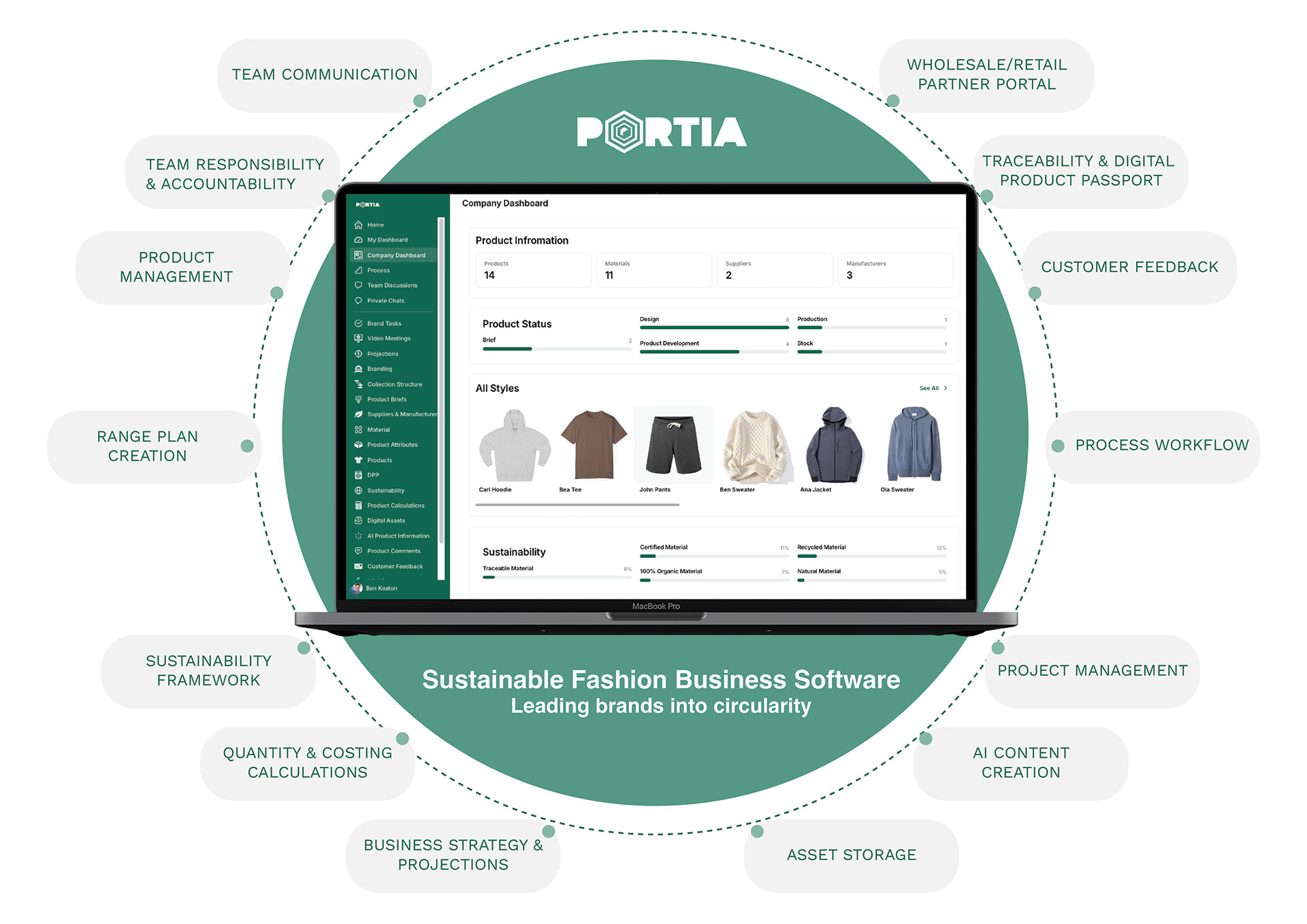
Portia is fashion PLM and Digital Product Passport software for small and medium product brands. See the Portia section below for what it does and doesn’t do.
Renoon
Renoon is a Milan-based DPP provider that combines advisory, a modular platform and managed services. It connects existing systems and adds supply chain traceability on top. Passports can be created at model, batch or item level and reached by QR code or NFC. Its integrations page lists Shopify as a ready integration for SMEs, alongside PLM and ERP connections. Its LCA article says it can calculate and structure product-level impact data. Pricing is by quote. Checked 26 October 2026.
Retraced
Retraced positions itself as an AI-first platform for product compliance and supplier lifecycle management in fashion. It maps suppliers from raw material to final product, validates supplier documents with AI and feeds the data into ERP, PLM and DPP workflows. Its site mentions managing identifiers at SKU and EPC level. Its Shopify App Store listing shows the app as not currently available. You buy through a demo. Checked 26 October 2026.
Tappr
Tappr has three products on one account: Brand Cloud (the product record), Trace (supplier data, from tier 1 to tier 4 by invitation link, with no supplier account needed) and Passport Builder (the passport page). Its identifiers use GS1 Digital Link by default, with SGTIN per item or LGTIN per batch. It lists more than 270 integrations, including Shopify. It publishes three plans (Community Edition, Operate and Enterprise). Activation, integrations and add-on modules are quoted on top. Checked 26 October 2026.
TrusTrace
TrusTrace is a Stockholm-based traceability platform for fashion, footwear and textile supply chains. Suppliers send primary data from all material tiers. Its DPP solution creates unique item-level IDs per product, size and colour variant and permanent QR codes, and it follows GS1 Digital Link standards. It calculates product environmental footprints (PEF), in the platform or through a partner, and has an open API for ERP and PLM. Its customers are mainly larger brands. Pricing is by quote. Checked 26 October 2026.
Where Portia fits, and where it doesn’t
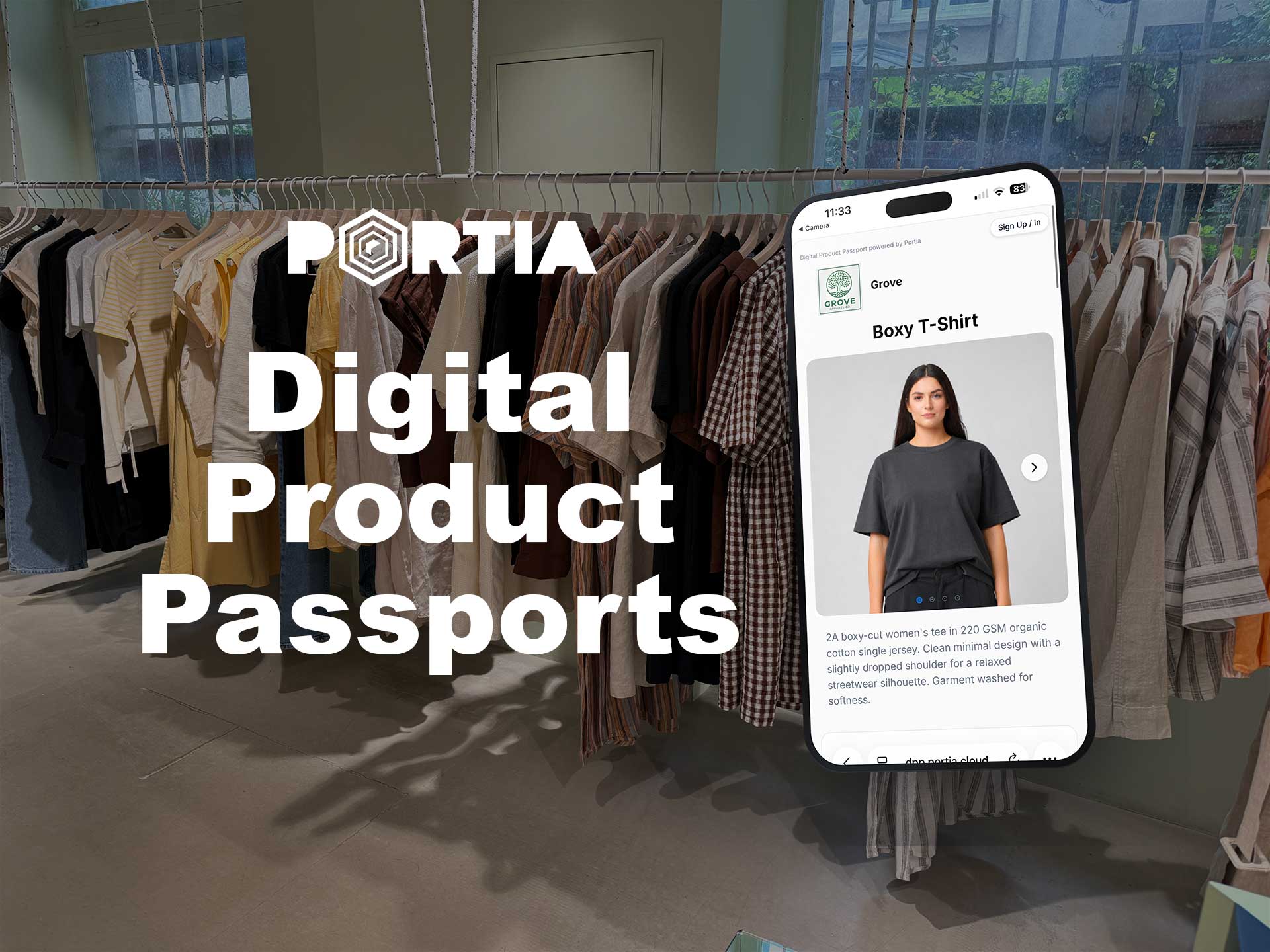
Portia is PLM-native: passports are built from the product, material and supplier data you enter while developing the product, so you don’t collect it twice. Specifically:
- Use it as your PLM, or alongside the one you have. Run product development in Portia, or import data from an existing PLM or ERP. See fashion PLM in Portia.
- Tier-1 supplier logins. Tier-1 suppliers can log in to enter their data and upload certificates.
- You choose the passport level: per model or style, per batch or per individual item, each reached through a QR code.
- Fast first passport. With your product data in a CSV and images ready, your first passport can be live in minutes. AI-powered matching maps the columns of your sheet to the right fields.
- Shopify. Portia pushes passport data to your Shopify store. See how Shopify passports work.
- Languages. Passports are available in English, Swedish, German and Dutch, with more languages coming.
- Data. Your data is hosted in the EU (Ireland), and you can export it whenever you want.
When Portia is not the right fit:
- You need LCA calculated for you. Portia does not calculate LCAs. Impact data is imported from partners or uploaded. An LCA-led tool such as Fairly Made, or an LCA partner, does that job.
- You need multi-tier supplier programmes. Portia’s supplier logins are for tier-1 suppliers. If you need to map and verify suppliers several tiers deep, look at a traceability-led tool such as TrusTrace, Retraced or Fairly Made.
- You need GS1 Digital Link, NFC or RFID. Portia uses QR codes only. Tappr, EON, Arianee and TrusTrace describe GS1 Digital Link support, and EON describes NFC and RFID carriers.
- You need a public API or two-way Shopify sync. Portia has no public API, and its Shopify integration pushes data one way. Custom integrations are available on request.
- You run many enterprise systems. If the job is connecting a large stack of ERP, PIM and PLM systems, a layered platform is built for that.
How to pick in 10 minutes
1. Write down where your product data lives today. Spreadsheets, a PLM, an ERP or Shopify. That tells you which type to start with. 2. Check what supplier data you need. For most small brands, tier-1 factory data and certificates come first. Use the textile DPP data checklist to see which fields come from suppliers. 3. Decide whether you need LCA now. If you do, make sure the passport tool can take impact data from your LCA tool or partner. 4. Shortlist two or three tools and ask the same questions. Our guide to choosing DPP software lists them. 5. Score your own readiness. The free fashion brand scorecard shows where your product data stands before you buy anything.
For the bigger picture, start with our Digital Product Passport software guide.
Sources
All vendor pages were read on 26 October 2026.
- Arianee: arianee.com/en, FAQ, Shopify plugin changelog
- EON: Digital Product Passports
- Fairly Made: fairlymade.com, plans and FAQ
- PicoNext: piconext.com, plans, Shopify app announcement
- Renoon: renoon.com, Digital Product Passport, integrations, LCA and the DPP
- Retraced: retraced.com, Shopify App Store listing
- Tappr: platform, Brand Cloud, integrations, plans
- TrusTrace: DPP solution, PEF, platform
- European Commission: Textile apparel and the Digital Product Passport (textile delegated act planned for Q4 2027)
Frequently asked questions
What is the best DPP software for a small fashion brand?
There is no single best tool. Brands without a PLM are usually best served by PLM-native software such as Portia. Brands with multi-tier supplier programmes fit traceability-led tools such as TrusTrace or Retraced, and brands that need LCA fit LCA-led tools such as Fairly Made.
Which DPP tools publish their pricing?
On 26 October 2026, Tappr published plan tiers on its website, and PicoNext published plan tiers by number of passports without prices. Arianee, EON, Fairly Made, Renoon, Retraced and TrusTrace sell through a quote or a demo. Portia’s pricing is on request.
Do I need GS1 Digital Link for a textile passport?
The textile requirements are not final. The European Commission plans to adopt the textile delegated act in Q4 2027, and that act will set the data carrier rules. Several tools already support GS1 Digital Link. Portia uses QR codes.
Can I create Digital Product Passports from Shopify?
Yes, several tools work with Shopify. PicoNext creates passports from Shopify product data, Tappr and Renoon list Shopify integrations, and Portia pushes passport data to your Shopify store. Check whether the sync runs one way or both ways.
Does DPP software calculate my product’s carbon footprint?
Only some tools do. Fairly Made runs LCAs and TrusTrace calculates PEF footprints, in the platform or through a partner. Portia does not calculate LCAs. It imports impact data from partners or uploads.
How was this comparison made?
We read each vendor’s own website on 26 October 2026 and scored every tool on the same seven criteria. We did not test the products hands-on. Where a vendor does not state something publicly, the table says so.
See a passport built from your own product data
Book a short demo and we’ll show you how a passport is built from product, material and supplier data in Portia, and whether it fits your brand.