Short answer: The EU’s Joint Research Centre (JRC) proposes 41 data fields for a textile Digital Product Passport, in groups: identification, producer and facility, materials, durability tests, chemicals, recyclability, recycled and organic content, environmental footprint, and care and repair. Most of it already sits in your tech packs, BOMs and supplier certificates. The list is a proposal until the delegated act is adopted.
Last verified: 22 October 2026. Written by Klas Kristiansson, co-founder of Portia and of the Stockholm design and apparel agency Desinder.
Free template: download the checklist as XLSX or as CSV. It has one row per field, with columns for your value, the evidence file, the owner and whether you have it yet.
Where does this list come from?
The ESPR, Regulation (EU) 2024/1781, sets the general rules for Digital Product Passports. Its Annex III lists the elements a passport can contain, such as the unique product identifier, commodity codes, compliance documentation, operator identifiers and unique facility identifiers (ESPR, Annex III). The exact data for clothing will be set in a separate delegated act for textile apparel. The European Commission plans to adopt it in Q4 2027 (European Commission).
To prepare that act, the JRC published a technical study on DPP content for textile apparel on 13 May 2026 (JRC study documents). Its Tables 13 and 14 list every proposed data field, at which level it should be reported (model, batch or item) and who should be able to see it. This checklist is built on those two tables.
Three things to keep in mind:
- It is a proposal. Fields, scores and methods can still change before the delegated act is adopted. We track every date in our ESPR Textile DPP Tracker.
- Seven fields are proposed as voluntary. They are marked “(voluntary)” in the tables and the template.
- “Typically comes from” is our guidance, based on how apparel brands work, not part of the JRC study.
Which products does it cover?
The JRC study covers finished textile apparel: t-shirts, shirts and blouses, sweaters and mid-layers, jackets and coats, pants and shorts, dresses, skirts and jumpsuits, leggings, tights and socks, underwear, swimwear, and textile accessories such as hats, scarves, belts and gloves. Workwear and sportswear are included. Smart and electronic textiles, personal protective equipment, medical devices and toys are excluded.
Fabrics, yarns and fibres do not get their own passport under this act. The study says the obligation “formally applies only to final products”. But much of the data in your garment’s passport, such as fibre origin, recycled content and chemicals, still has to come from those upstream suppliers.
What do model, batch and item level mean?
- Model level: one set of data for every unit of a style, such as fibre composition or care instructions.
- Batch level: data per production batch, such as the factory that made it or the chemicals used in a dye lot.
- Item level: data per individual garment, through a unique identifier on each piece.
The JRC proposes batch identifiers as the minimum, “to be populated with batch or model information according to the granularity level assigned” to each field. Item-level identifiers would be voluntary. Brands could start with item-level codes and fill them with batch or model data at first. The study calls this the inheritance model.
Access works in three tiers: public (anyone who scans the code), legitimate interest (for example recyclers) and authority only (market surveillance, customs and the Commission). Operator contact details, conformity certificates and detailed footprint parameters are proposed as restricted, not public.
The 41 fields, group by group
Identification and classification (5)
| Field | Level | Who can see it | Typically comes from |
|---|---|---|---|
| Unique product ID (voluntary) | Item | Public | Brand or its DPP provider |
| Batch ID | Batch | Public | Brand with the tier-1 factory (production order) |
| Model ID | Model | Public | Brand (style number) |
| ESPR and PEFCR product category | Model | Public | Brand |
| Commodity code (e.g. CN/TARIC) | Model | Public | Brand, customs broker or importer |
Producer and facility (4)
| Field | Level | Who can see it | Typically comes from |
|---|---|---|---|
| Unique operator identifier (manufacturer, importer, other) | Batch | Public | Brand, importer, tier-1 factory |
| Operator name and address (manufacturer, importer, other) | Batch | Public | Brand, importer, tier-1 factory |
| Operator contact (manufacturer, importer, other) | Batch | Authority only | Brand, importer, tier-1 factory |
| Unique facility identifier | Batch | Public | Tier-1 factory |
Materials (2)
| Field | Level | Who can see it | Typically comes from |
|---|---|---|---|
| Fibre composition | Model | Public | Brand tech pack, confirmed by the fabric mill |
| Components specification | Model | Public | Brand BOM, trim and component suppliers |
Durability (mechanical properties) (5)
| Field | Level | Who can see it | Typically comes from |
|---|---|---|---|
| Robustness score | Model | Public | Calculated from test results |
| Visual inspection | Batch (self-declaration) / Model (third-party certified) | Public | Factory QC or test lab |
| Spirality | Batch (self-declaration) / Model (third-party certified) | Public | Factory QC or test lab |
| Dimensional change | Batch (self-declaration) / Model (third-party certified) | Public | Factory QC or test lab |
| Conformity certification | Batch (self-declaration) / Model (third-party certified) | Authority only | Test lab or certification body |
Chemicals and end-of-life (5)
| Field | Level | Who can see it | Typically comes from |
|---|---|---|---|
| Substances of concern (SoC) | Batch | Public | Fabric mill, dye house, chemical supplier or test lab |
| Location of the SoC | Batch | Legitimate interest | Fabric mill, dye house or test lab |
| Concentration of SoC | Batch | Public | Test lab or chemical supplier |
| Instructions for safe use | Batch | Public | Brand |
| Information for disassembly, reuse, recycling and end-of-life | Batch | Legitimate interest | Brand (design and product development) |
Recyclability (2)
| Field | Level | Who can see it | Typically comes from |
|---|---|---|---|
| Recyclability score | Model | Public | Calculated from composition and construction |
| Conformity certification | Model | Authority only | Certification body |
Recycled content (5)
| Field | Level | Who can see it | Typically comes from |
|---|---|---|---|
| Recycled content (%) | Model | Public | Yarn or fabric supplier, with certificate |
| Type of waste (e.g. pre- or post-consumer) | Batch | Public | Fibre or yarn supplier |
| Weight (excluding trims) | Batch | Legitimate interest / Authority only | Tier-1 factory or brand |
| Amount of recycled material | Model | Legitimate interest / Authority only | Calculated from weight and recycled share |
| Conformity certification | Batch | Authority only | Certification body (e.g. transaction certificate) |
Organic content and EU Ecolabel (4)
| Field | Level | Who can see it | Typically comes from |
|---|---|---|---|
| Organic content (%) (voluntary) | Model | Public | Fabric mill, with certificate |
| Amount of organic material (voluntary) | Model | Legitimate interest / Authority only | Calculated from weight and organic share |
| Conformity certification (voluntary) | Batch | Authority only | Certification body |
| EU Ecolabel (voluntary) | Model | Public | Brand (only if awarded) |
Environmental footprint (5)
| Field | Level | Who can see it | Typically comes from |
|---|---|---|---|
| Carbon/environmental footprint: class of performance | Model | Public | LCA partner or footprint data provider |
| Carbon/environmental footprint: absolute value | Model | Legitimate interest / Authority only | LCA partner or footprint data provider |
| Carbon footprint calculation parameters | Model | Legitimate interest / Authority only | LCA partner or footprint data provider |
| Weight | Model | Public | Brand or tier-1 factory |
| Conformity declaration | Model | Authority only | Brand |
Care, repair and warranty (4)
| Field | Level | Who can see it | Typically comes from |
|---|---|---|---|
| Care instructions | Model | Public | Brand (care label artwork) |
| Repair instructions (voluntary) | Model | Public | Brand |
| Contact of repair services offered by the brand (voluntary) | Model | Public | Brand |
| Warranty duration | Model | Public | Brand |
Which fields can you fill today?
Sort the fields into three piles before you contact a single supplier.
1. You already have it. Model ID, product category, fibre composition, components, care instructions, weight, warranty and your own operator details sit in your tech packs, BOMs and label artwork. Fibre composition is already required on labels under the Textile Labelling Regulation, (EU) No 1007/2011. This pile is mostly copy and structure.
2. Your suppliers have it. Facility identifiers, batch IDs, recycled and organic content with certificates, and test results for visual inspection, spirality and dimensional change. The JRC notes that these durability tests are already common internal quality checks, but the results usually sit in PDFs rather than structured data. Ask tier-1 factories first. They can often pass on mill and dye-house documents.
3. Wait for the method. The robustness score, recyclability score, footprint class and the substance-of-concern details depend on methods the delegated act will define. Collect the inputs you can (composition, construction, test reports, chemical declarations), but don’t pay for new calculations until the method is published.
Who usually supplies each group?
| Source | Fields they usually hold |
|---|---|
| Your own team | Model ID, product category, commodity code, components, care, repair and warranty information, safe-use and end-of-life information, your operator identifiers |
| Tier-1 factory | Facility identifier, batch ID, weight, QC test results, the factory’s own operator details |
| Fabric mill, yarn spinner, dye house | Fibre composition confirmation, recycled and organic content, type of waste, chemical and substance data |
| Test lab or certification body | Durability test reports, conformity and content certificates |
| LCA or footprint partner | Footprint class, absolute values and calculation parameters |
| Importer or customs broker | Importer details and commodity codes, if you don’t import yourself |
For a pilot, pick 10 to 20 styles from your next collection and fill piles 1 and 2 for those first. That shows you quickly where the gaps are. For more on supplier data, see our guide to traceability software for small fashion brands.
How to use the free template
1. Download the XLSX (or the CSV for Google Sheets or Numbers). 2. Make one copy per style, or add a style column if you want one sheet for the whole pilot. 3. For each row, note where the value lives today (tech pack, BOM, supplier email, certificate) in “Your value / where it lives”. 4. Link the evidence file, such as a test report or transaction certificate. 5. Name an owner for every row that says “Partly” or “No”. 6. Filter on “No” to get your supplier request list.
The template uses the field names, levels and access tiers from the JRC study, so you can update it when the delegated act is published.
Common mistakes
- Treating the passport as a label project. Most of the effort is collecting and checking the data, not designing the passport page.
- Collecting everything at item level. The JRC proposes batch identifiers as the minimum. Item-level data is voluntary, and it multiplies the work.
- Asking suppliers for “all DPP data”. Send each supplier only the rows they own, with an example.
- Keeping certificates as loose PDFs. Link each certificate to the product and batch it covers, with its expiry date.
- Assuming certifications cover everything. Content certificates support recycled and organic claims, but they don’t give you the durability, chemical or footprint fields.
- Waiting for the final act. Pile 1 and pile 2 don’t depend on it, and supplier data takes time.
Where does Portia fit?
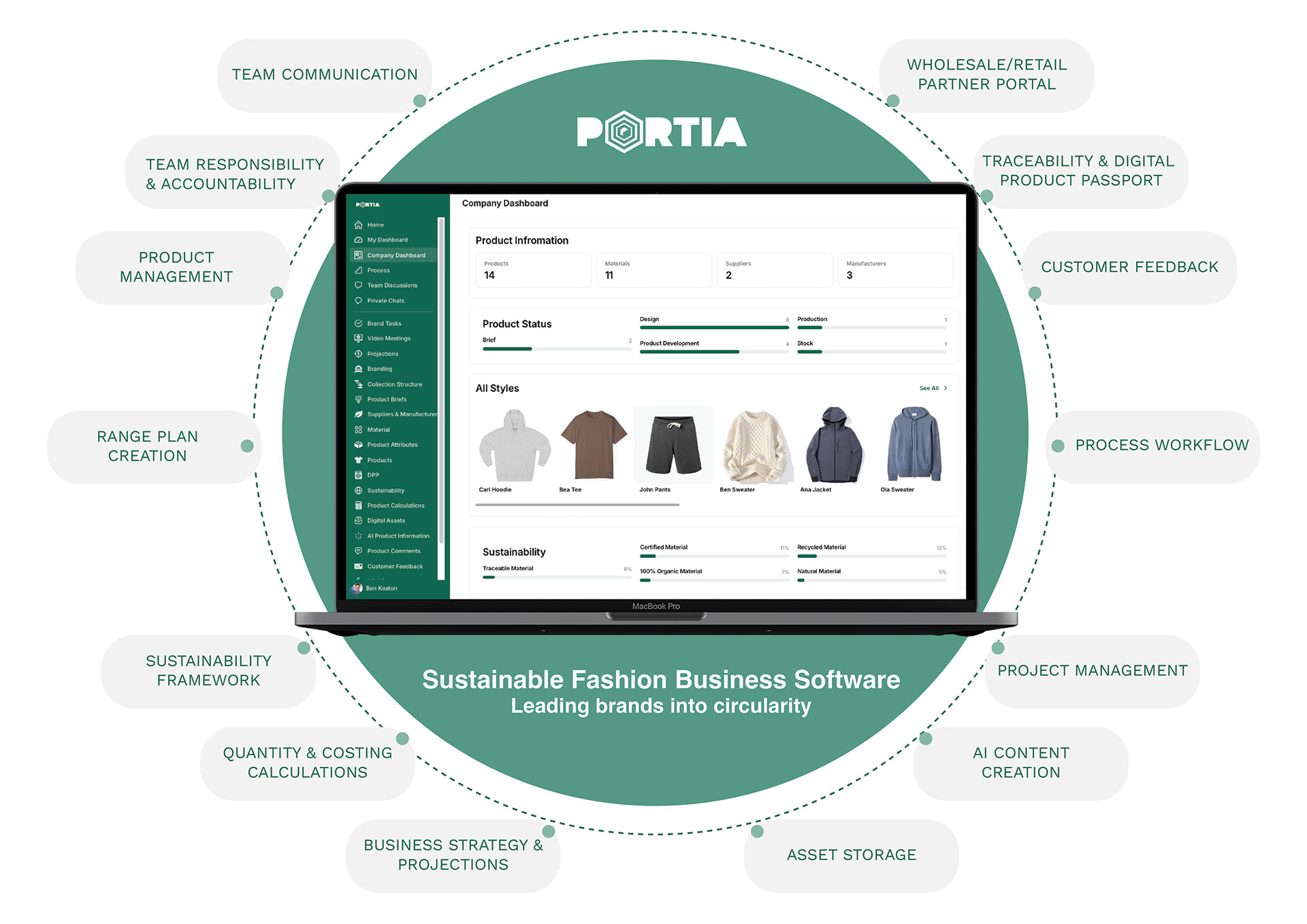
Portia is a fashion PLM with Digital Product Passports built in, so most of this data is captured during product development rather than in a separate project. In Portia:
- Products, materials, suppliers and certificates are kept in the product record. You can use Portia as your fashion PLM, or import data from an existing PLM or ERP.
- Tier-1 suppliers can log in to enter their data and upload certificates.
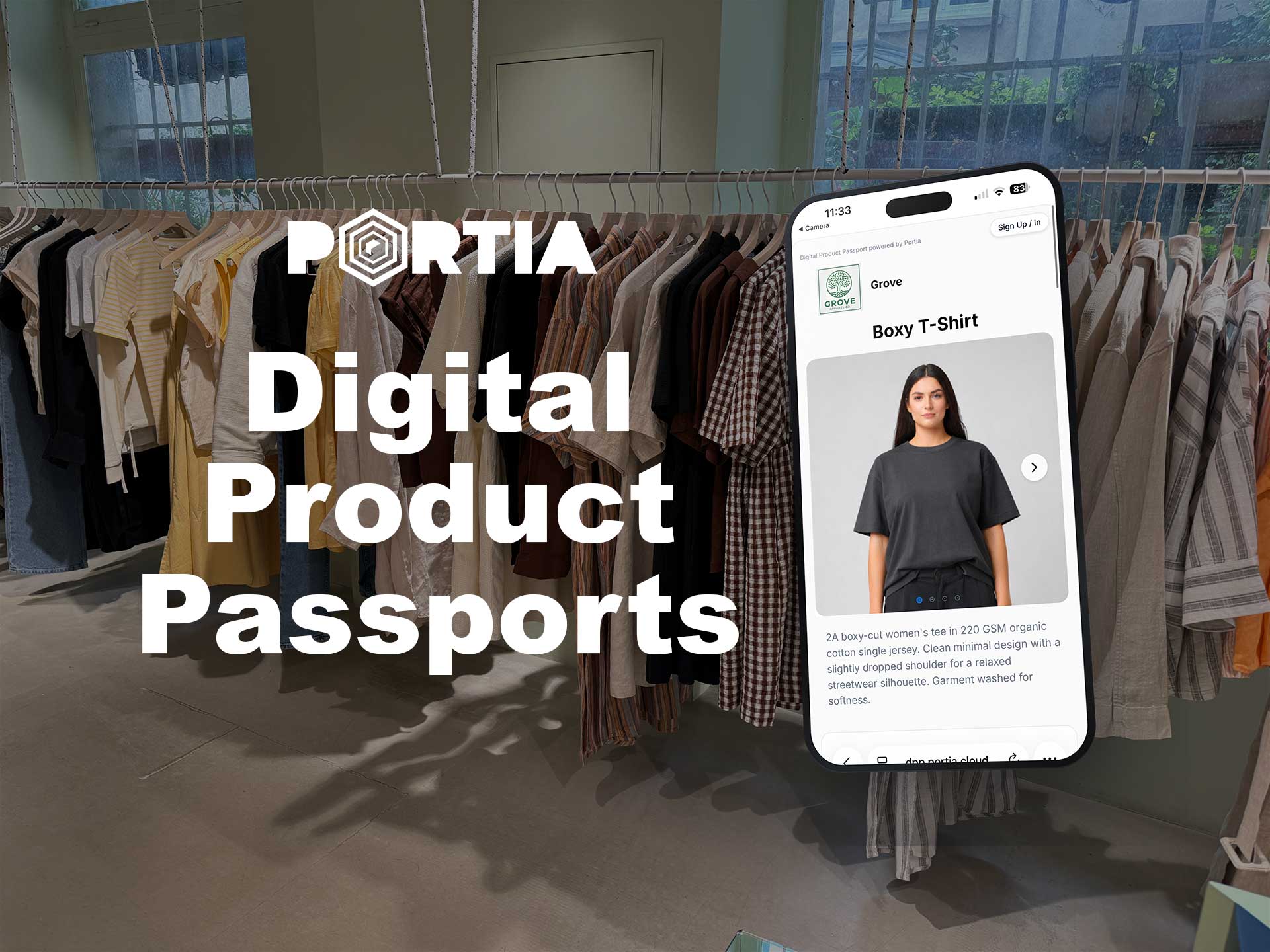
- You choose the passport level: model or style, batch or individual item. Each passport is reached through a QR code.
- Sheet uploads are mapped for you. When you upload product data as a sheet, Portia’s AI-powered matching maps the columns so materials, suppliers and other data end up in the right fields. With your product data in a CSV and images ready, your first passport can be live in minutes.
- Impact data is imported from partners or uploaded. Portia does not calculate LCAs or footprints itself.
- Your data is hosted in the EU (Ireland) on infrastructure certified to SOC 2 Type 2 and ISO 27001, and you can export your data whenever you want.
Portia is not the right fit if you need multi-tier supplier mapping beyond tier 1, in-house LCA calculation or NFC tags. See our Digital Product Passport software page for what Portia covers, or our guide to choosing DPP software to compare tools.
Related reading
- The questions textile brands keep asking about DPP: 21 answers on timing, certifications and the harder data points.
- Digital Product Passport checklist: the organisational steps around the data.
- The 5 types of DPP software
- Digitalt produktpass för kläder (in Swedish)
Sources
- Regulation (EU) 2024/1781 (ESPR), Annex III, EUR-Lex
- European Commission: Textile apparel and the Digital Product Passport (planned adoption Q4 2027)
- JRC Product Bureau: Study on DPP content for textile apparel products under ESPR, 13 May 2026 (Tables 2, 13 and 14; section 4.3)
- Regulation (EU) No 1007/2011 on textile fibre names and labelling, EUR-Lex
All sources last verified on 22 October 2026.
Frequently asked questions
What data is required in a textile Digital Product Passport?
The final list will be set by the ESPR delegated act for textile apparel, planned for adoption in Q4 2027. The JRC study proposes 41 fields covering identification, producer and facility, fibre composition and components, durability tests, substances of concern, recyclability, recycled and organic content, environmental footprint, and care, repair and warranty information.
Is the JRC field list final?
No. The JRC study of 13 May 2026 is a technical proposal to support the delegated act. Fields, scores and calculation methods can still change before the act is adopted, so treat the list as the best current guide.
Does every garment need its own passport?
Not under the JRC proposal. It proposes batch identifiers as the minimum, filled with batch or model data depending on the field. Item-level identifiers would be voluntary.
Which DPP data will be public?
The JRC proposes that most product information is public, including fibre composition, durability results, recycled content, the footprint class, and care and repair information. Operator contact details, conformity certificates and detailed footprint parameters would be restricted to authorities or to actors with a legitimate interest, such as recyclers.
Do fabric mills and yarn suppliers need their own DPP?
Not under the textile apparel act. The JRC study says the obligation applies only to final products, and fabrics, yarns and fibres are excluded. Brands still need data from those suppliers for fields such as recycled content and chemicals.
Can I use a spreadsheet to collect DPP data?
Yes, for a pilot. The free template on this page works in Excel, Google Sheets or Numbers. As the number of styles, suppliers and certificates grows, keeping versions and evidence in step becomes the hard part, which is where DPP software helps.
See your own product data as a passport
Book a short demo and we’ll show you how a passport is built from product, material and supplier data in Portia.