
Last updated: 19 October 2026. Next scheduled update: November 2026. All dates below were checked against EUR-Lex, the European Commission and the Joint Research Centre (JRC) on the date above.
Short answer: There is no legal deadline for textile Digital Product Passports yet. The European Commission plans to adopt the ESPR delegated act for textile apparel in Q4 2027, and that act cannot normally apply until at least 18 months after it enters into force. If the plan holds, textile DPPs become mandatory in mid-to-late 2029 at the earliest.
This tracker lists every official date and document that matters for clothing brands, says clearly what is law, what is planned and what is only an estimate, and records what changed each month.
What is the status of textile DPP rules right now?
A Digital Product Passport (DPP) is, in the words of the Ecodesign Regulation, “a set of data specific to a product” that is “accessible via electronic means through a data carrier” (Regulation (EU) 2024/1781, Article 2). The framework is in force; the textile-specific rules are not yet written.
| Milestone | Date | Status (19 Oct 2026) | Source |
|---|---|---|---|
| ESPR adopted | 13 June 2024 | Law | EUR-Lex |
| ESPR published in the Official Journal | 28 June 2024 | Law | EUR-Lex |
| ESPR enters into force | 18 July 2024 | In force | EUR-Lex (Art. 80) |
| ESPR working plan 2025–2030 adopted; textiles/apparel ranked first, indicative adoption 2027 | 16 April 2025 | Adopted plan (not law) | COM(2025) 187 |
| Revised Waste Framework Directive (textile EPR) enters into force | 16 October 2025 | In force | Directive (EU) 2025/1892 |
| Derogations to the ban on destroying unsold apparel and footwear adopted | 9 February 2026 | Law (applies from 19 July 2026) | Delegated Regulation (EU) 2026/296 |
| JRC study on DPP content for textile apparel published | 13 May 2026 | Preparatory study (not law) | JRC Product Bureau |
| DPP Registry implementing regulation adopted | 16 July 2026 (in force 6 August 2026) | Law | Implementing Regulation (EU) 2026/1778 |
| Ban on destroying unsold apparel, clothing accessories and footwear (large companies) | 19 July 2026 | Applies | ESPR Art. 25 |
| DPP Registry and testing environment go live | 20 July 2026 | Live | European Commission |
| Six of eight harmonised DPP standards available | July 2026 | Published | European Commission |
| Decision on the remaining two DPP standards | November 2026 | Planned (indicative) | Commission DPP timeline |
| First mandatory DPPs (certain batteries, not textiles) | 18 February 2027 | Scheduled | Commission DPP timeline |
| Delegated act on DPP service providers | Q2–Q3 2027 (the Commission timeline lists both) | Planned (indicative) | Commission DPP timeline |
| Member States must transpose the textile EPR rules | 17 June 2027 | Legal deadline | Directive (EU) 2025/1892 |
| ESPR delegated act for textile apparel adopted | Q4 2027 (textile page) / Q3–Q4 2027 (general timeline) | Planned (indicative) | Commission textile page |
| Textile EPR schemes established in every Member State | by 17 April 2028 | Legal deadline | Directive (EU) 2025/1892 |
| Textile DPP requirements apply | Mid-to-late 2029 at the earliest | Estimate (our calculation) | See below |
| Destruction ban and disclosure duty extend to medium-sized companies | 19 July 2030 | Law | ESPR Arts. 24–25 |
The Commission itself flags that its timeline is “indicative” and “may evolve as legislative and technical work progresses” (textile apparel page).
When will the textile DPP become mandatory?
The honest answer is: not before the textile delegated act exists, and then not for at least 18 months. Three rules in the ESPR decide the date:
- The delegated act sets the obligation. Products “can only be placed on the market” with a DPP once a delegated act requires it (ESPR Article 9(1)).
- Parliament and Council get two months to object, extendable by two more, before a delegated act can enter into force (ESPR Article 72(6)).
- The 18-month rule. The date of application “shall not be earlier than 18 months from its entry into force”, except in duly justified cases (ESPR Article 4(4)). The Commission summarises this as a transition period of “at least 18 months” (DPP timeline).
Worked example (our estimate, not an official date): if the textile act is adopted in December 2027, the scrutiny period runs to roughly February–April 2028, entry into force follows publication, and 18 months later lands around autumn 2029. Adoption earlier in Q4 2027 moves that to around mid-2029. Any slip in adoption moves the whole chain.
Why do different sources say 2027, 2028 or 2029?
Most of the confusion comes from mixing up two different dates:
- Adoption is when the Commission adopts the textile delegated act. Currently planned for Q4 2027.
- Application is when brands must actually have passports. That is at least 18 months after the act enters into force.
Articles that say “DPPs are mandatory from 2027” usually mean adoption. Articles that say “2028” generally predate the current Commission timeline or skip the scrutiny period. Even the Commission’s own pages differ slightly: the textile page says Q4 2027, while the general DPP timeline groups textiles, aluminium and tyres under Q3–Q4 2027. We will update this tracker when either page changes.
What will the textile delegated act decide?
The ESPR lists what each product-specific delegated act has to specify for the passport (Article 9(2)):
- the data to be included in the passport
- which data carrier(s) to use, and the layout and positioning of the carrier
- whether the passport is at model, batch or item level
- how customers can see the passport before buying, including online
- who can access which data, and who can create or update it
- how long the passport must remain available (at least the expected lifetime of the product)
Some essentials already apply to every DPP regardless of product: it must be connected through a data carrier to a persistent unique product identifier, be based on open and interoperable standards “without vendor lock-in”, and a back-up copy must be kept with a DPP service provider (Article 10). The passport must also stay available after an insolvency or liquidation of the company that created it (Article 11(e)).
What does the JRC study propose for clothing?
The JRC study on DPP content for textile apparel products (13 May 2026) is the main technical input for the future act. It is a proposal that, in its own words, requires “validation through extensive stakeholder consultation”. Its main points:
- Four content blocks: product identification and classification, producer identification, product information, and compliance documentation.
- Scope: textile apparel, with a “textile product” defined as at least 80% textile fibres by weight. Footwear is handled separately; the working plan commissions a footwear study to be completed by the end of 2027.
- Granularity: a phased approach, with model-level data for most product characteristics, batch-level data “where variability is material”, and item-level identifiers on a voluntary basis.
- Access: role-based access, with data such as fibre composition public and sensitive data restricted to authorities or actors with a legitimate interest.
- Languages: the study flags that the DPP must be available in all official EU languages.
- Out of scope: data carriers, registry design and technical architecture are explicitly left for later work.
The study builds on the JRC’s methodology for defining DPP data requirements.
Who has to provide the textile passport?
According to the Commission’s textile apparel page, DPP requirements apply primarily to economic operators placing textile apparel on the EU market. “Depending on the economic circumstances, these operators may be manufacturers, producers or importers.” Distributors and dealers must ensure a DPP is available for the products they sell. Before a product is placed on the market, its passport must be registered in the EU DPP Registry, which stores identifiers and metadata rather than the full passport data.
Which textile rules already apply today?
Two textile obligations are already law, separate from the DPP:
- Destruction of unsold clothing. Since 19 July 2026, large companies may not destroy unsold apparel, clothing accessories and footwear, except under the derogations in Delegated Regulation (EU) 2026/296. Medium-sized companies follow from 19 July 2030; micro and small enterprises are exempt (ESPR Article 25). The Commission says a standard disclosure format applies from February 2027 (Commission news, 9 February 2026).
- Extended producer responsibility (EPR) for textiles. Every Member State must have an EPR scheme for textile, textile-related and footwear products by 17 April 2028 (Directive (EU) 2025/1892). The exact rules and fees are set nationally.
The revision of the Textile Labelling Regulation, which could introduce digital labels, has not been proposed yet as far as we can find. The Commission’s review page still refers to a planned proposal “by the second quarter of 2026”. We are treating this as delayed, with no new date.
What should a small fashion brand do now?
Nothing here is mandatory yet, but the data takes longer to collect than the software takes to set up. Sensible no-regret steps:
- Structure your product data now: fibre composition, components, origin, care and repair information per style.
- Ask your tier-1 suppliers for factory details and certificates in a consistent format.
- Decide which level you can realistically support today: model, batch or item.
- Read the JRC field proposal and map your current data against it.
- Treat any voluntary passport you publish now as a pilot, not as proof of meeting rules that do not exist yet.
For the bigger picture, read our complete guide to Digital Product Passports for textiles, and if you are comparing tools, see the 5 types of DPP software. Swedish readers can find a Swedish summary in Digitalt produktpass för kläder.
Change log
| Date | Change |
|---|---|
| 19 October 2026 | Tracker published. All dates checked against EUR-Lex, the European Commission and the JRC. |
Frequently asked questions
When do textile Digital Product Passports become mandatory?
There is no legal date yet. The Commission plans to adopt the textile delegated act in Q4 2027, and it can normally apply no earlier than 18 months after entering into force, so mid-to-late 2029 at the earliest.
Is the ESPR already in force?
Yes. Regulation (EU) 2024/1781 entered into force on 18 July 2024. It is a framework: textile passport requirements only start once the textile delegated act applies.
What is the JRC textile DPP study?
It is a preparatory study published on 13 May 2026 that proposes which data a clothing passport should contain. It is not law and will be refined during the impact assessment of the delegated act.
Do micro and small brands need a DPP?
The ESPR contains no general DPP exemption for small companies; the scope will be set in the textile delegated act. The regulation does require the Commission to take SMEs’ needs into account and Member States to offer SMEs support such as one-stop shops (Article 22). Separately, micro and small enterprises are exempt from the ban on destroying unsold clothing.
Is the EU DPP Registry live?
Yes. The Commission launched the registry and a testing environment on 20 July 2026, under Implementing Regulation (EU) 2026/1778.
Get your product data ready
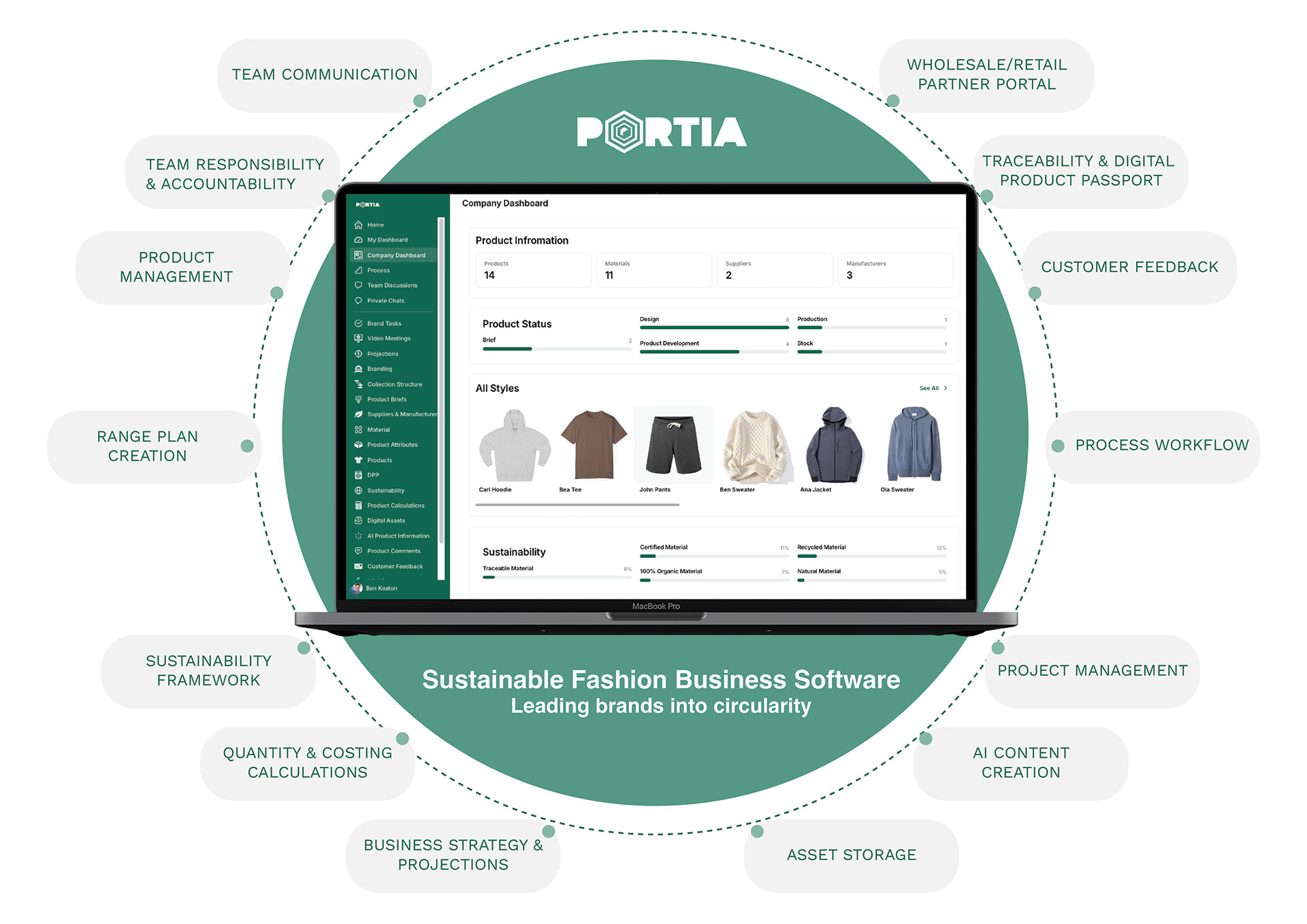
Portia is fashion PLM and Digital Product Passport software for small and medium brands. Passport data is built from the product, material and supplier information you already manage in Portia. With your product data in a CSV and images ready, your first passport can be live in minutes.