Short answer: Renoon is a Milan-based Digital Product Passport (DPP) provider that combines advisory, a modular platform and managed services. Small and mid-size fashion brands that want a different setup usually look at four groups: PLM-native tools such as Portia, marketing-led tools such as Tappr and PicoNext, traceability-led tools such as TrusTrace and Retraced, and LCA-led tools such as Fairly Made.
Last verified: 27 October 2026. Written by Klas Kristiansson, co-founder of Portia and Managing Director of the Stockholm design and apparel agency Desinder.
We make Portia, so this is a list written by a vendor. To keep it fair, we describe every tool, Renoon included, only from what the company publishes on its own website, and we say so when something is not stated publicly. Tools within each group are listed alphabetically. This is not a ranking.
First: which Renoon are we talking about?
Some older articles and AI answers still describe Renoon as a shopping app for sustainable fashion. That was true once. Renoon started in 2020 as a consumer app that helped shoppers find sustainable clothing across many online stores.
Today Renoon is a business-to-business company. Its website describes it as a Digital Product Passport provider for compliance and traceability, working with brands on DPP strategy, technology and operations. So when people search for “Renoon alternatives” today, they almost always mean other Digital Product Passport software, not other shopping apps. That is what this article covers.
What Renoon offers today
From Renoon’s own pages, read on 27 October 2026:
- Three parts: advisory (mapping where a company stands and planning the work), the Renoon platform, and managed services where Renoon’s team runs the operational work.
- A modular platform that connects systems a brand already has and adds supply chain traceability and Digital Product Passports on top.
- Granularity: its cost guide describes passports at model, batch or item level.
- Data carriers: QR codes and NFC tags.
- Integrations: its integrations page lists Shopify as a ready integration for SMEs, alongside PLM and ERP connections.
- Impact data: its LCA article says Renoon can calculate and structure product-level impact data.
- Scale: its About page says more than 10 million products carry Renoon passports.
- Pricing model: sales-led. You book a call; prices are not published.
Why brands look for Renoon alternatives
Renoon is a serious option, and many brands should shortlist it. Brands that look elsewhere usually have one of these reasons:
- They want software they run themselves. Renoon’s model includes advisory and managed services. Some small teams would rather have a tool they set up and run in-house.
- They don’t have a PLM. Renoon connects to the systems you already have. If your product data lives in spreadsheets, you may want a tool where product development and the passport happen in one place.
- They need published plans. Some brands want to compare published plans before they talk to sales.
- They need a specific strength. For example built-in LCA, multi-tier supplier mapping, or GS1 Digital Link identifiers from day one.
Renoon alternatives, grouped by type
There are five types of DPP software, depending on what each tool was originally built to do. Renoon is a layered platform with advisory and managed services. Here are the alternatives by type.
| Tool | Type | Closest to Renoon on | Main difference from Renoon | Pricing model |
|---|---|---|---|---|
| Arianee | Layered (open DPP infrastructure) | Connecting existing data to passports | Open infrastructure across several product categories, with GS1 Digital Link | Project quote |
| EON | Layered (product identity) | Connecting many systems; model, batch or item | Persistent product identity behind resale, repair and authentication | Sales-led, not published |
| Fairly Made | LCA-led and traceability-led | Analyst support for supplier tracing | LCA and ecodesign built in, strong focus on France | Named plans, quote |
| PicoNext | Marketing-led | Shopify integration | Passports generated from existing product listings with an AI assistant | Plan tiers by number of passports |
| Portia | PLM-native | Model, batch or item; Shopify | Product development (PLM) and passports in one tool, run by your own team | On request (demo) |
| Retraced | Traceability-led | Supply chain traceability | Supplier onboarding, AI document checks and supplier lifecycle management | Demo, quote |
| Tappr | Marketing-led, with supplier tracing | Shopify; supplier data collection | Published plans and GS1 Digital Link by default | Published plans; extras quoted |
| TrusTrace | Traceability-led (enterprise) | Supply chain traceability | Multi-tier primary data and PEF footprints, mainly for larger brands | Quote |
Sources: each vendor’s own website. Renoon was read on 27 October 2026, the other vendors on 26 October 2026. Full list at the end of the article.
PLM-native: Portia
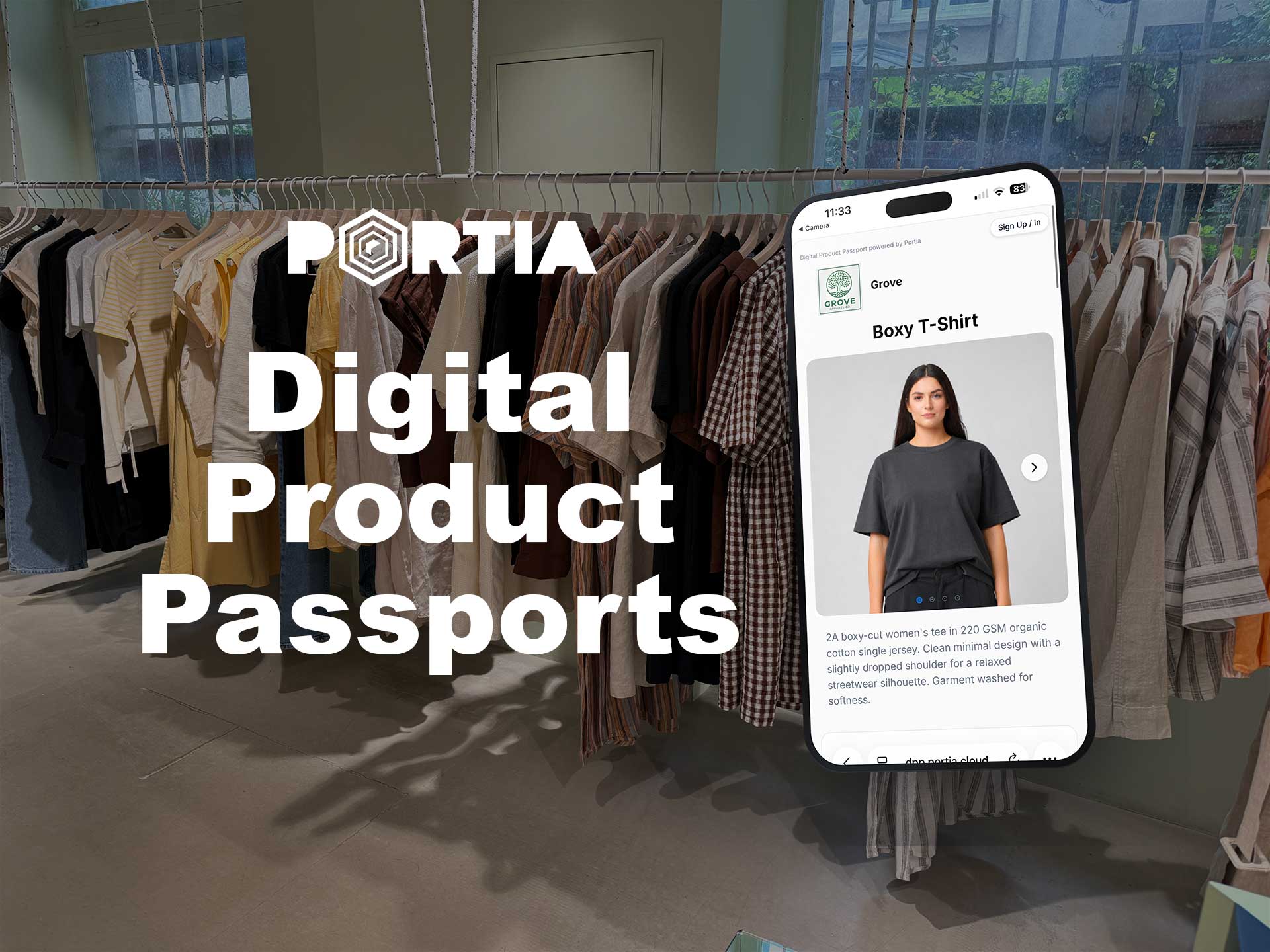
Portia is fashion PLM and Digital Product Passport software for small and medium product brands. Passports are built from the product, material and supplier data you enter while developing the product, so you don’t collect the same data twice. You can use Portia as your PLM, or alongside an existing PLM or ERP by importing your data. Tier-1 suppliers can log in to enter data and upload certificates. You choose the passport level (model or style, batch or item), and each passport is reached through a QR code. With your product data in a CSV and images ready, your first passport can be live in minutes. See what’s in Portia’s DPP software and fashion PLM in Portia.
Marketing-led: PicoNext and Tappr
PicoNext builds passports with a DPP Planner, templates and a generative AI assistant that summarises product data. Its Shopify app creates passports from Shopify product data. It publishes Essentials, Pro and Enterprise plans by number of passports.
Tappr has three products on one account: Brand Cloud (the product record), Trace (supplier data from tier 1 to tier 4 by invitation link) and Passport Builder. Its identifiers use GS1 Digital Link by default, and it lists more than 270 integrations, including Shopify. It publishes its plans; activation, integrations and add-ons are quoted on top.
Traceability-led: Retraced and TrusTrace
Retraced focuses on product compliance and supplier lifecycle management in fashion. It maps suppliers from raw material to final product and checks supplier documents with AI, then feeds the data into ERP, PLM and DPP workflows.
TrusTrace is a Stockholm-based traceability platform where suppliers send primary data from all material tiers. Its DPP solution creates item-level IDs per product, size and colour variant, follows GS1 Digital Link and calculates product environmental footprints (PEF), in the platform or through a partner. Its customers are mainly larger brands.
For what supplier traceability looks like inside Portia, with tier-1 supplier logins, see traceability software in Portia.
LCA-led: Fairly Made
Fairly Made is a French traceability and environmental impact platform for fashion, textile and leather. Its analyst team traces products from tier 1 to raw materials, and it runs LCAs and offers an ecodesign module. It is a natural fit for brands selling in France.
Layered: Arianee and EON
Arianee describes itself as open DPP infrastructure for several product categories, with GS1 Digital Link identifiers and passports pushed to the EU DPP registry. Cost is estimated per project.
EON builds persistent digital IDs for products, batches, serialised items and materials, supports GS1 Digital Link and EPCIS 2.0, and covers resale, repair and authentication.
For the full scoring of all nine tools on the same seven criteria, see our comparison of the best DPP software for small fashion brands. Head-to-head Portia comparisons will be added to our compare page, which collects all our DPP and PLM comparisons in one place.
Small brand or mid-size brand: what changes
Small brands (roughly one person on product data, spreadsheets, a Shopify store): the biggest risk is a project that needs more people than you have. Look for a tool your own team can set up, that takes a spreadsheet import, and that works with Shopify. PLM-native and marketing-led tools are usually the closest fit.
Mid-size brands (a product team, a PLM or ERP, several factories): the question is whether you add a passport layer on top of your systems or move product development into one tool. A layered platform such as Renoon, EON or Arianee fits the first path. A PLM-native tool such as Portia fits the second. If supplier mapping several tiers deep is the main job, look at a traceability-led tool.
When to stay with Renoon
Stay with Renoon, or choose it, if:
- You want advisory and managed services, so an outside team plans and runs much of the work with you.
- You already have a PLM, ERP or PIM and want a platform that connects them rather than replaces them.
- You want product-level impact data handled by the same provider.
- You need NFC as well as QR codes.
Where Portia fits, and where it doesn’t
Portia fits small and medium fashion brands without a PLM, or with one they want to replace, that want product development and passports built from the same data and run by their own team.
Portia is not the right fit if:
- You need LCA calculated for you. Portia does not calculate LCAs. Impact data is imported from partners or uploaded.
- You need multi-tier supplier programmes. Portia’s supplier logins are for tier-1 suppliers.
- You need GS1 Digital Link, NFC or RFID. Portia uses QR codes only.
- You need a public API or two-way Shopify sync. Portia has no public API, and its Shopify integration pushes passport data one way. Custom integrations are available on request.
- You want an outside team to run the work. Portia is software your team runs. If you want managed services, Renoon is built for that.
Questions to ask before you switch provider
If you already have passports live with one provider and are thinking of moving, ask these first:
- Will the QR codes already printed on my products keep working? A passport has to stay reachable for the product’s life, so check who controls the link behind each code and how it can be redirected.
- Can I export all my product and supplier data, and in what format?
- Which supplier data will I need to collect again?
- Can both systems run side by side during a pilot of 10–20 styles?
Our guide to choosing DPP software has 25 questions to ask any vendor, and the textile DPP data checklist shows which fields usually come from suppliers. To see where your own product data stands, take the free fashion brand scorecard.
Sources
Renoon pages were read on 27 October 2026. The other vendor pages were read on 26 October 2026.
- Renoon: renoon.com, About, Digital Product Passport, integrations, LCA and the DPP, DPP cost guide (granularity)
- Renoon’s history as a consumer app: Renewable Matter, “Startup: Renoon helps to find ethical and sustainable fashion companies”
- Arianee: arianee.com/en, FAQ
- EON: Digital Product Passports
- Fairly Made: fairlymade.com, plans and FAQ
- PicoNext: piconext.com, plans
- Retraced: retraced.com
- Tappr: platform, integrations, plans
- TrusTrace: DPP solution, PEF
Frequently asked questions
Is Renoon a shopping app?
Not any more. Renoon started in 2020 as a consumer app for finding sustainable fashion. Today it is a business-to-business Digital Product Passport provider that combines advisory, a modular platform and managed services for brands.
What are the best Renoon alternatives for a small fashion brand?
It depends on where your product data lives. Brands without a PLM often look at PLM-native tools such as Portia. Shopify-first brands look at marketing-led tools such as PicoNext or Tappr. Brands with deep supplier programmes look at TrusTrace or Retraced, and brands that need LCA look at Fairly Made.
Is there a Renoon alternative that includes a PLM?
Yes. Portia is fashion PLM and Digital Product Passport software in one tool, so passports are built from the product and supplier data you enter during development. You can also run it alongside an existing PLM or ERP by importing your data.
Does Renoon publish its pricing?
No. On 27 October 2026, Renoon sold through a call with its team and did not publish prices. Tappr and PicoNext publish plan tiers. Portia’s pricing is on request.
Can I switch DPP provider after my passports are live?
Usually yes, but check two things first: that the QR codes already printed on your products keep resolving after the move, and that you can export all your product and supplier data from your current provider.
When should I stay with Renoon?
Stay with Renoon if you want advisory and managed services, want to connect an existing PLM, ERP or PIM rather than replace it, or need NFC as well as QR codes.
See a passport built from your own product data
Book a short demo and we’ll show you how a passport is built from product, material and supplier data in Portia, and whether it fits your brand.